
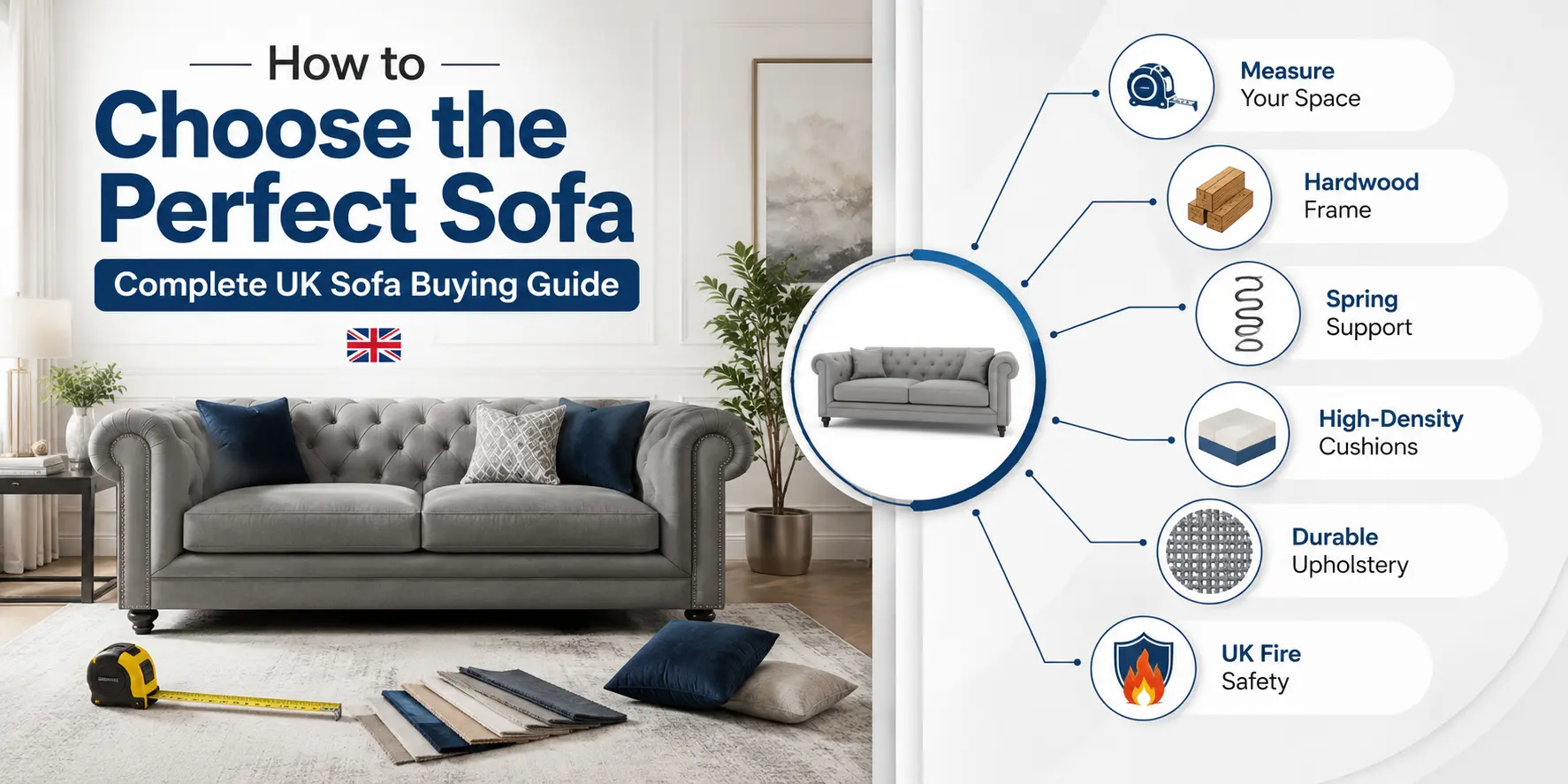
How to Choose the Perfect Sofa: Complete UK Sofa Buying Guide

Sofa Buying Guide: Buying a new sofa is one of the biggest furniture investments you’ll make. This complete UK Sofa Buying Guide explains everything you need to know, from choosing the right size and frame construction to cushion fillings, upholstery fabrics, and UK fire safety standards.
Before investing in new living room furniture, browse our collection of luxury sofas to compare styles, materials, and sizes before making your final decision.Buying a sofa is going to be one of the biggest investments you make towards your living space. Apart from the looks of the piece, the sofa is also the key element that makes up the structure and practicality of your living room space. Since a well-made sofa should last 8-15 years, making a proper choice means looking beyond its style to assess its inner frame, suspension system, stuffing density, and quality of the fabric material.
Read this Sofa Buying Guide to make a smart furniture investment.
Here is the full plan on how to choose a sofa that will perfectly fit your living space in UK.
1. Spatial Architecture & Layout Configurations
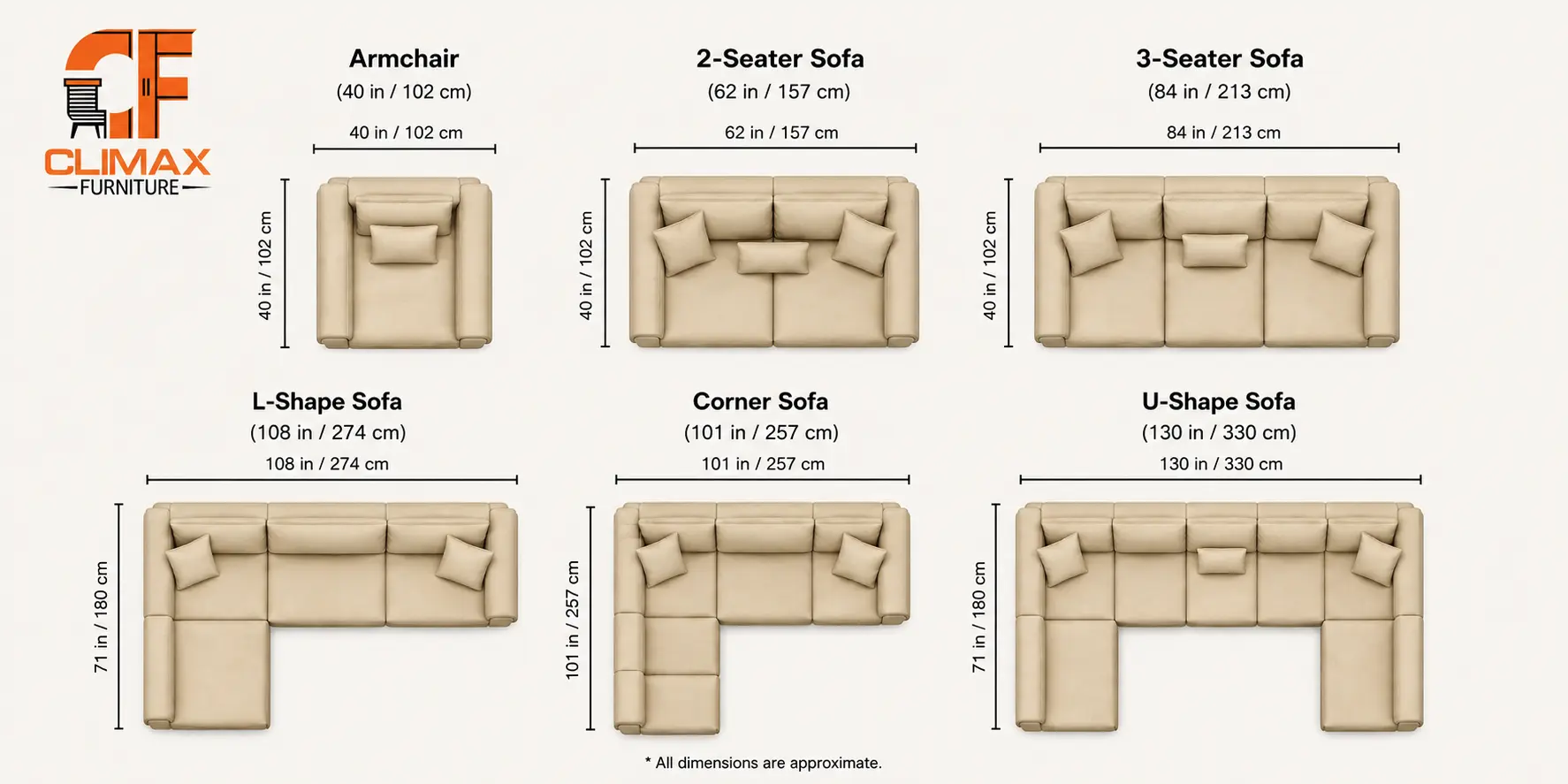
Choosing a particular arrangement of the sofa requires you to understand how these various designs will fit into the dimensions of your room and the activities that you will engage in there. You need to pay attention to such things as doors, windows, and high traffic zones to be assured that you select a design that will increase comfort and convenience. It is equally vital to think about the overall design and colors of your interiors, since they determine the way your sofa will match your interiors.
| Sofa Configuration | Typical Seating Capacity | Best Suited Room Type | Primary Advantage |
| 2-Seater / Loveseat | 2 Adults | Compact living rooms, snugs, UK Victorian terraces | Space-saving profile; easily fits narrow corridors |
| 3-Seater Sofa | 3 Adults | Standard rectangular or square family rooms | Versatile balance of seating capacity and footprint |
| Corner / L-Shaped | 4 to 6 Adults | Open-plan living areas, large square spaces | Maximizes corner dead space; creates natural room dividers |
| Modular Sofa | Flexible / Custom | Complex layouts, awkward room angles, modern flats | Reconfigurable units; individual modules pass tight access points |
| Sofa Bed / Sleeper | 2 to 3 Adults | Multi-functional guest rooms, studio apartments | Space-efficient dual purpose for overnight hosting |
2. Dimensional Precision & Access Audits
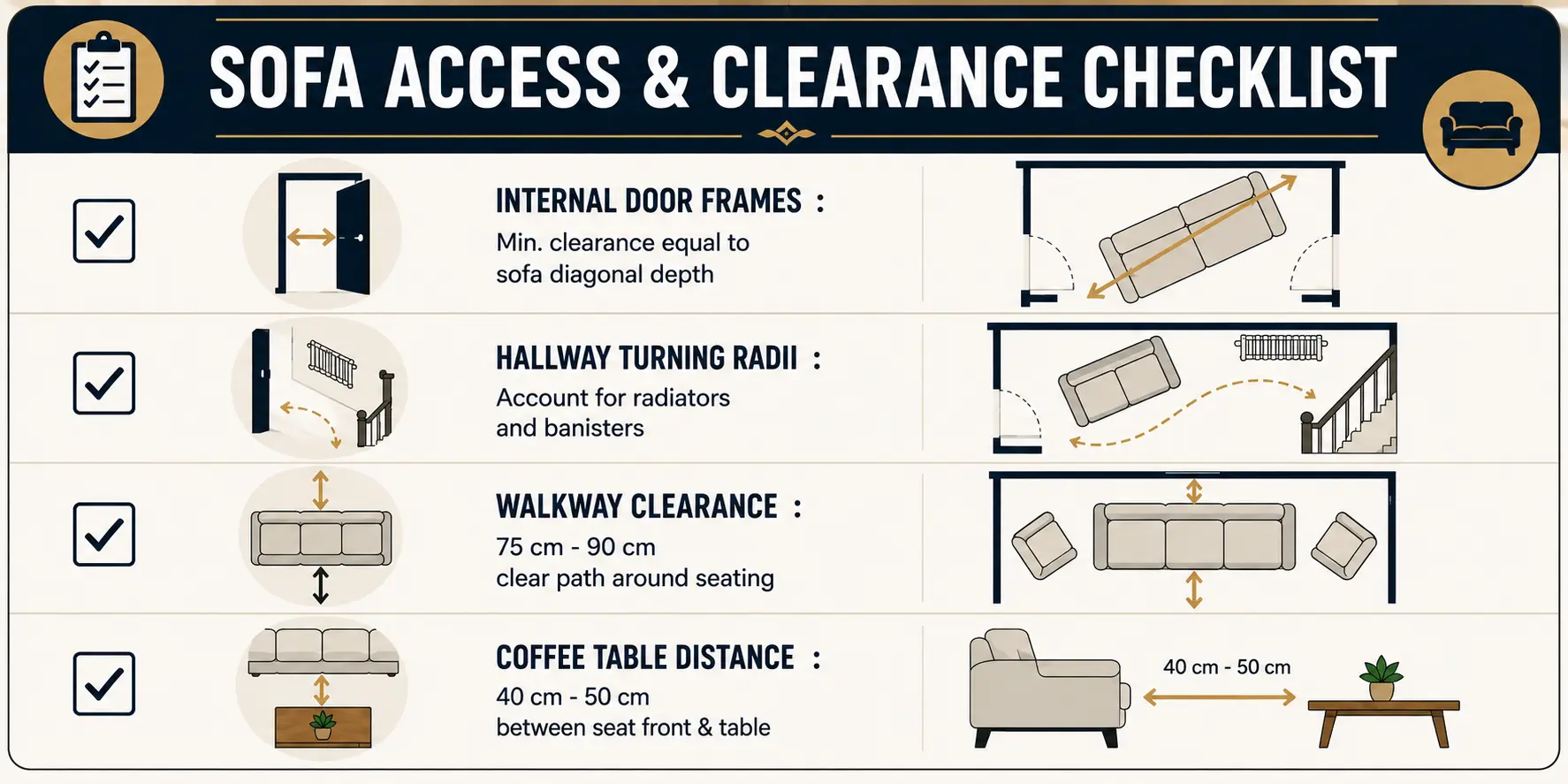
A frequent purchasing error occurs when a sofa fits the room dimensions but fails to pass through entry pathways. UK homes—ranging from traditional period properties with narrow stairwells to modern new-builds with tight hallway turns—demand careful access auditing.
Method for Conducting Access Audit
Width of Access Doors to Entrance, staircase, and Lifts: Determine the minimum width of access doors to the entrance, staircase, and lifts.
Diagonal Depth of Sofa: The minimum door width can be tested using the diagonal depth of the sofa. This measurement is taken from the top corner of the arm to the bottom corner of the seat of the sofa. If the diagonal depth of your sofa is smaller than the minimum door width, then it can fit through the doorway.
Other dimensions to consider: Consider the wall radiators, low ceiling, bulkheads and light fittings along the access route too.
Recommendation if you have a narrow corridor or upper level apartment: It will be advisable for you to choose a sofa with bolt-on legs or knock down frame for additional clearance of 15 cm.
3. Internal Frame Engineering & Joint Construction
The internal frame forms the load-bearing backbone of the sofa. What lies beneath the upholstery dictates whether the seat maintains its shape or suffers structural failure within a few years.
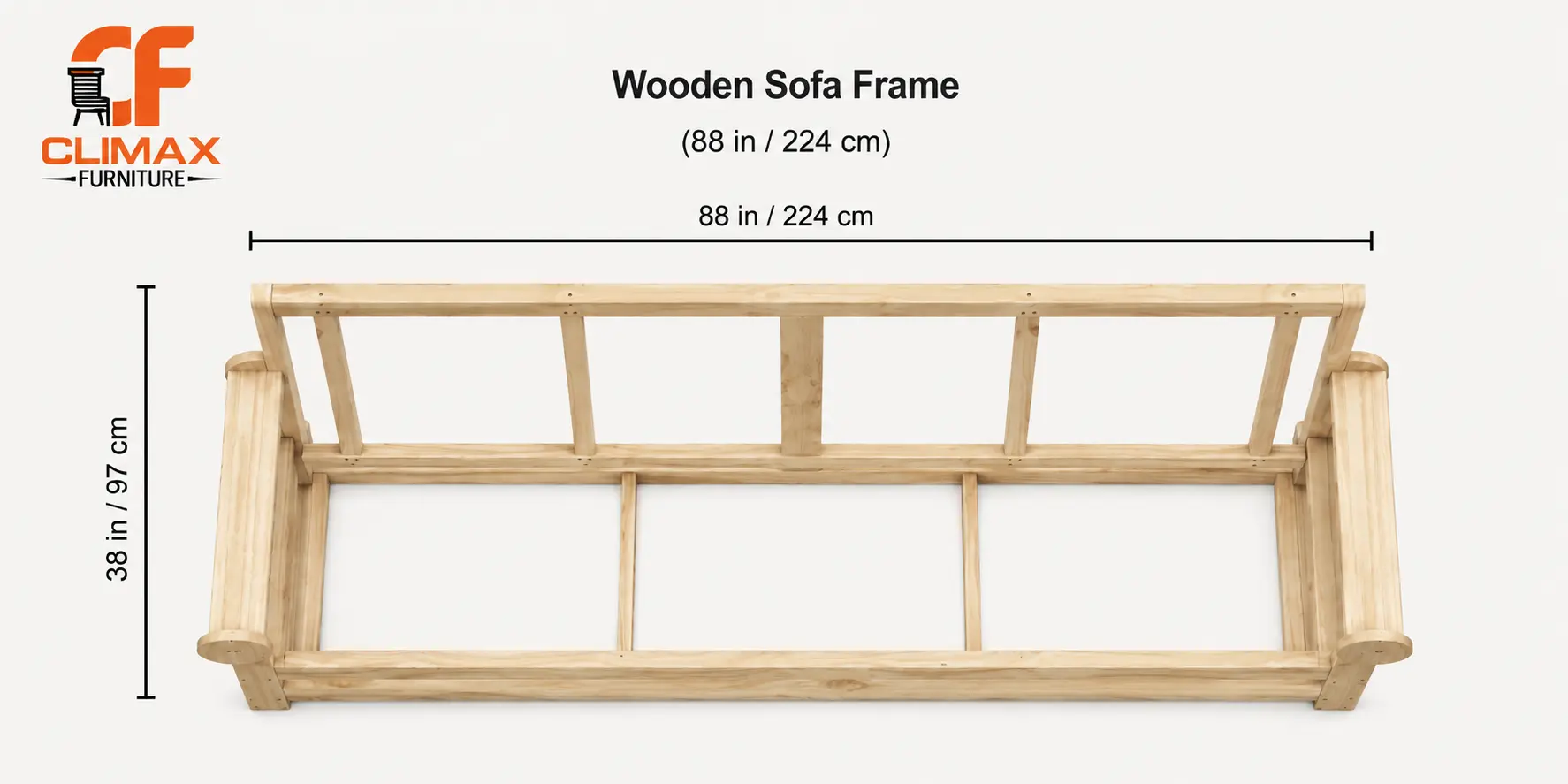
FRAME MATERIAL HIERARCHY
Kiln Dried Hard Wood (Golden Standard): These are the hard woods such as Beech or Birch that undergo the drying process in kilns so that the moisture content is reduced to 8-12 %. It makes the wood resistant to warping or splitting. It is necessary to glue, dowel and strengthen the joints using corner blocks.
Soft Wood (Pine/Spruce): These are inexpensive but flexible when used in heavy-duty. They do not provide adequate resistance to the attachment.
Engineered Wood (Particle board): This is unsuitable for rails although high quality hardwood plywood can be used for the side panels.
4. Deck Suspension Systems: Support & Weight Distribution
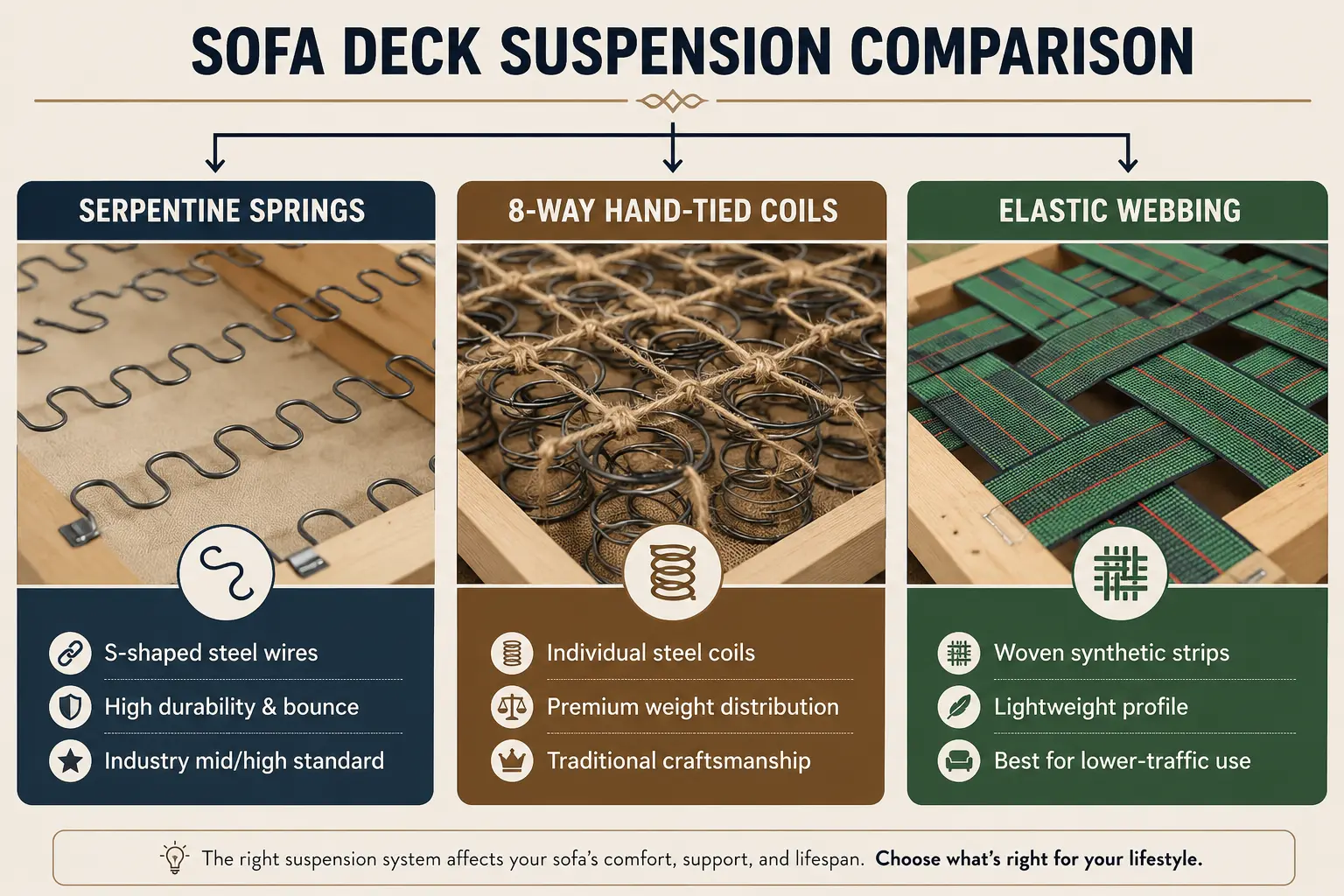
The suspension system sits beneath the seat cushions, working in tandem with the frame to absorb impact and provide bounce-back support.
Serpentine (Sinuous) Springs: Continuous S-shaped steel springs attached horizontally to the seat framework. Quality serpentine springing uses heavy-duty steel secured with silent, nylon-lined clips to prevent noise.
Eight-Way Hand-Tied Springs: Time-honored standard of conventional upholstery. Coil steel springs sewn together in eight directions through heavy cord, forming an interconnecting suspension system that reacts to body weight in a dynamic way.
Elastic Webbing: Cross-woven synthetic strips stretched over the seat base. Dense elastic webbing allows slim construction for contemporary low-profile sofas, while poor quality webbing can elongate under repeated stress.
5. Cushion Fillings & Support Cores
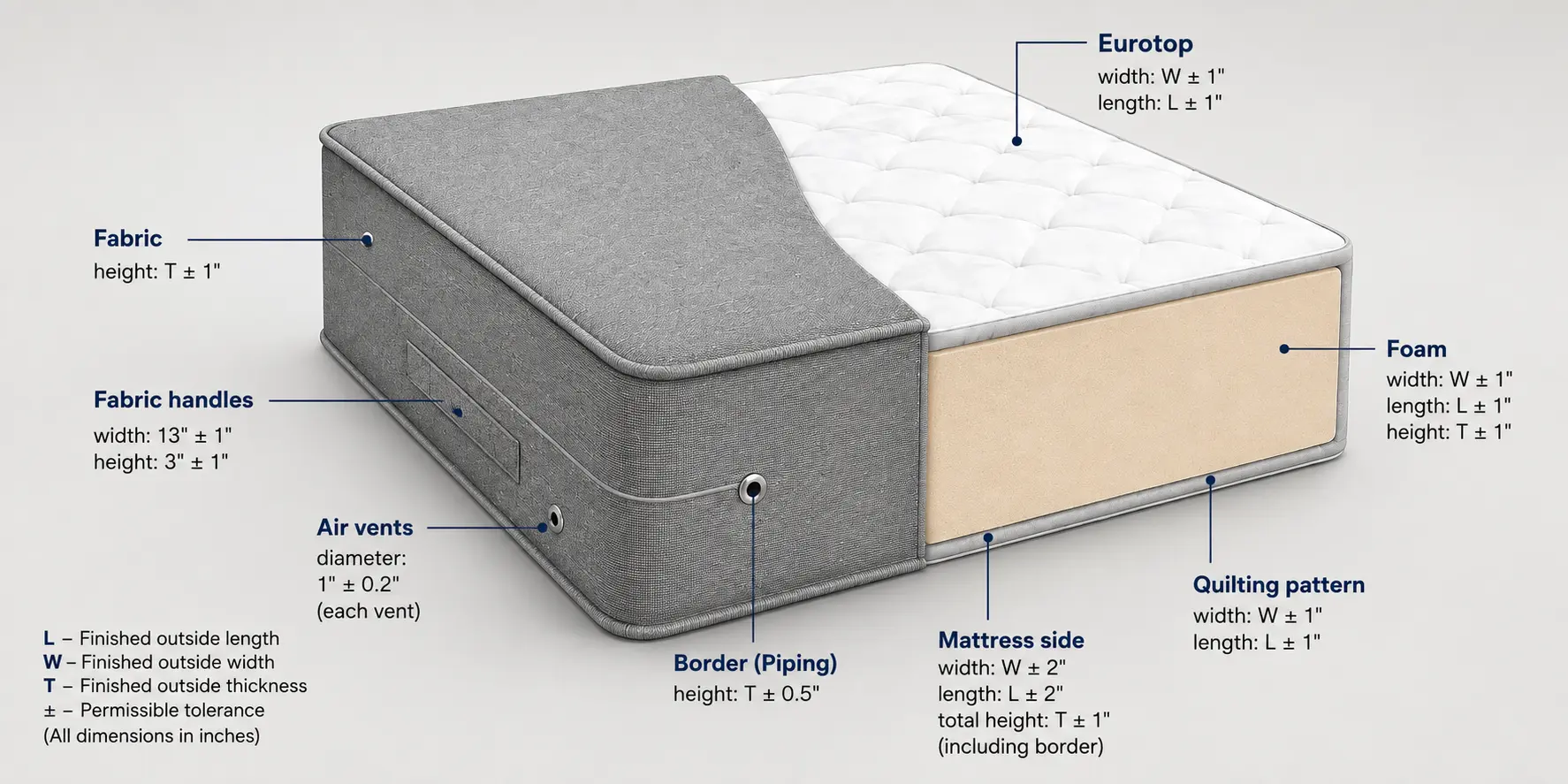
The choice of cushioning cores defines both the initial comfort and ongoing physical integrity of a chair.
Performance Analysis of Core Materials
Polyurethane HR Foam: Aim to have densities of at least 35 kg/m³. HR foam guarantees instant regain of shape, sharp edges, and no need for plumping on a daily basis.
Feather and Down Mixes: Provide comfortable sinking into a chair and a loose appearance. But pure feather-filled cushions need daily plumping and dressing to keep their shape.
Foam-Core Encased in Fiber or Feather (Hybrid): A combination of HR foam core with an outer layer of fiber or down. It features the bounce of the inner layer and comfort of the outer one.
Explore our fabric sofas and velvet sofas, built with premium high-density foam cushions for lasting comfort.
6. Upholstery Fabrics & Durability Ratings
Discover our collection of Velvet Chesterfield Sofas for a luxurious look with excellent durability.
Understanding the Martindale Rub Test
In the UK, fabric abrasion resistance is measured via the Martindale Rub Test:
- 15,000–20,000 Rubs: General domestic use (suitable for light-use sitting rooms or guest spaces).
- 25,000–30,000 Rubs: Heavy domestic use (recommended for main living room seating).
- 30,000+ Rubs: Severe domestic / commercial grade (ideal for busy family homes with children and pets).
Material Selection Matrix
| Fabric Type | Tactile Feel | Maintenance Level | Best For |
| Performance Synthetics | Soft, structured | Low (Stain-resistant finishes available) | Active family living spaces |
| Short-Pile Velvet | Luxurious, smooth | Low–Medium (Resists pet claw snagging) | High-traffic, stylish modern spaces |
| Top-Grain Leather | Firm, smooth | Low (Easy wipe-down; ages with patina) | High-durability environments |
| Natural Blends (Linen/Wool) | Breathable, textured | Medium–High (Prone to creasing/spotting) | Formal lounges, traditional interiors |
7. UK Safety Standards & Compliance
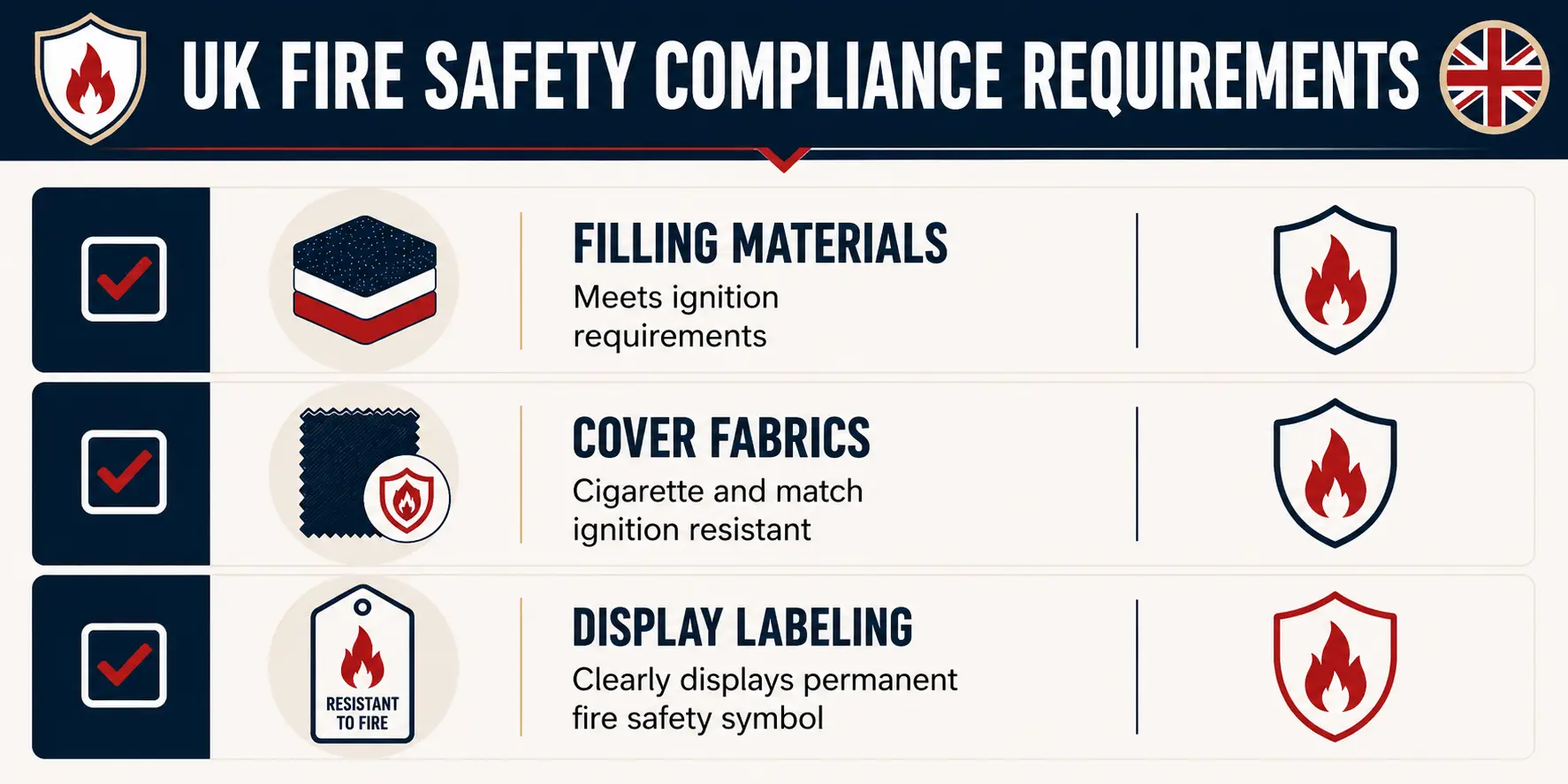
All domestic upholstered furniture supplied in the United Kingdom must comply with the Furniture and Furnishings (Fire) (Safety) Regulations.
Follow this Sofa Buying Guide to find the ideal sofa for your living space.
Verify that any sofa purchased carries a permanent fire safety label sewn into the frame or under seat cushions, confirming compliance with standards.
Frequently Asked Questions : Sofa Buying Guide
How can I test frame quality when shopping in a showroom?
Lift one front corner or leg of the sofa roughly 15 cm off the ground. If the opposite front leg lifts simultaneously, the frame is rigid and structurally sound. If the opposite leg remains flat on the floor or flexes noticeably, the frame lacks adequate corner blocking or reinforcement.
What seat height and seat depth are best for upright back support?
A seat height of 45–50 cm paired with a shallower seat depth of 80–88 cm promotes an upright seating posture that supports the lumbar spine and allows your feet to rest flat on the floor. Deep seats (above 95 cm) encourage lounging or slouching.
Are fixed covers or removable covers better?
Removable, dry-cleanable covers offer easier maintenance and allow for future reupholstery or color updates. Fixed covers offer a tighter, more tailored aesthetic that maintains clean seam lines over time.
How much clearance space should be left around a sofa?
Maintain a minimum of 45 cm between the front edge of the seat cushion and your coffee table. Main walking routes through the room require at least 75–90 cm of unobstructed clearance.
How do I prevent cushion sagging over time?
Rotate and flip loose seat cushions weekly to equalize wear patterns. For foam cushions, ensure the core density is rated at 35 kg/m³ or higher to prevent collapse over extended daily use.
Summary & Key Takeaways
Selecting the right sofa comes down to a structured evaluation process:
- Verify Dimensions First: Measure entryways, hallways, and living room space before settling on a design.
- Insist on Hardwood Construction: Choose kiln-dried beech or birch frames with dowelled, glued, and corner-blocked joints.
- Match Suspension to Usage: Opt for serpentine steel springs or 8-way hand-tied coils for long-term support.
- Select High-Density Fillings: Look for high-resilience foam cores (35 kg/m³+) or foam-and-feather hybrids to minimize maintenance.
- Check Fabric Performance & Safety: Target 25,000+ Martindale rub test cycles for primary family seating and verify UK fire safety compliance tags.