Best Dining Tables for Small UK Homes: 4-Seater & 6-Seater Picks

If you live in a typical UK terrace, a post-war semi, or one of the newer flats where the kitchen, dining area and living room all share the same floor space, you already know the problem. You want a proper dining table. Somewhere to eat without balancing a plate on your knee, work occasionally, help with homework, and — if we’re being honest in November — seat people properly at Christmas. What you don’t want is a table that swallows the room for the other 364 days of the year.
That’s why choosing the best dining table for a small UK home isn’t really about finding the smallest table you can tolerate. It’s about finding the size you’ll use every day, without giving up the room you need when family turns up. There’s a difference, and it’s where most people go wrong.
It doesn’t help that new UK homes are built tight to begin with. The government’s nationally described space standard allows a one-bedroom home for one person at just 39 square metres — so if your dining area feels squeezed, it isn’t your imagination. The table has to work harder in that space, which is exactly why the dining tables and sets at Climax Furniture lean so heavily on extending designs, as you’ll see below.
Start with how you actually live, not how the showroom looks
In practice, most small-home households fall into one of two camps.
In the first, two to four people eat at the table most days. A partner, maybe one or two children, the occasional friend. For them, a good 4-seater is not a compromise at all — it’s exactly right.
In the second, there are still only two, three or four people day to day, but Christmas, birthdays and Sunday lunches regularly bring six people together. That household doesn’t necessarily need a big table out all year. It needs a table that can become a 6-seater when it matters.
That distinction matters because too many people buy for the biggest gathering they host once a year. They squeeze a fixed 6-seater into a small dining room, spend the rest of the year walking sideways around it, and quietly start eating in the living room anyway.
Buy for your normal week first. Then solve the occasional bigger meal with shape, chairs or an extending top — not by permanently losing half your room.
The numbers that actually matter: space per person
Forget vague descriptions like “compact” or “generously sized.” Retailers use them loosely. Measurements are more honest.
As a reliable guide, each person needs:
- About 60cm of table width to eat comfortably without knocking elbows
- 55cm as an absolute minimum for a short meal — workable, but cosy
- Around 40cm of depth in front of them for a plate, cutlery and a glass
- At least 60cm of legroom underneath, which is why bulky legs and thick aprons underneath a table can cause more trouble than the top itself
Then there’s the room around the table, and this is what most people overlook. You need roughly 75cm to 90cm between the edge of the table and the wall (or radiator, sideboard or kitchen units) just to pull a chair out and sit down. If someone needs to walk behind a seated person, aim for 90cm to 120cm. Less than 70cm and every meal starts with a shuffle.
A quick reality check before you order: measure the room, then subtract that clearance from both sides. What you’re left with is your real maximum table size. It is often 20cm to 30cm smaller than people first assume — especially in UK homes with deep skirting, a radiator on the dining wall, or a door that opens into the space.
Best 4-seater dining tables for small homes
For most small UK homes, a 4-seater is the sweet spot. These are the shapes that tend to work best.
1. Rectangular table, around 120cm x 75cm
This is probably the safest all-round choice. At 120cm long, you get 60cm per person on each side. At 75cm to 80cm wide, two place settings fit opposite each other without the middle of the table disappearing under plates.
It also sits neatly against a wall, in a bay, or along one side of a kitchen-diner. Push one long side against the wall on quiet days and pull it out when you have guests. Simple, but it works.
Avoid going much narrower than 70cm if you regularly serve food from dishes in the centre. Serving bowls need somewhere to go.
2. Round table, 90cm to 100cm across
A round table has one underrated advantage in a small home: no corners. That sounds minor until you’ve caught your hip on a rectangular table twenty times in a narrow room.
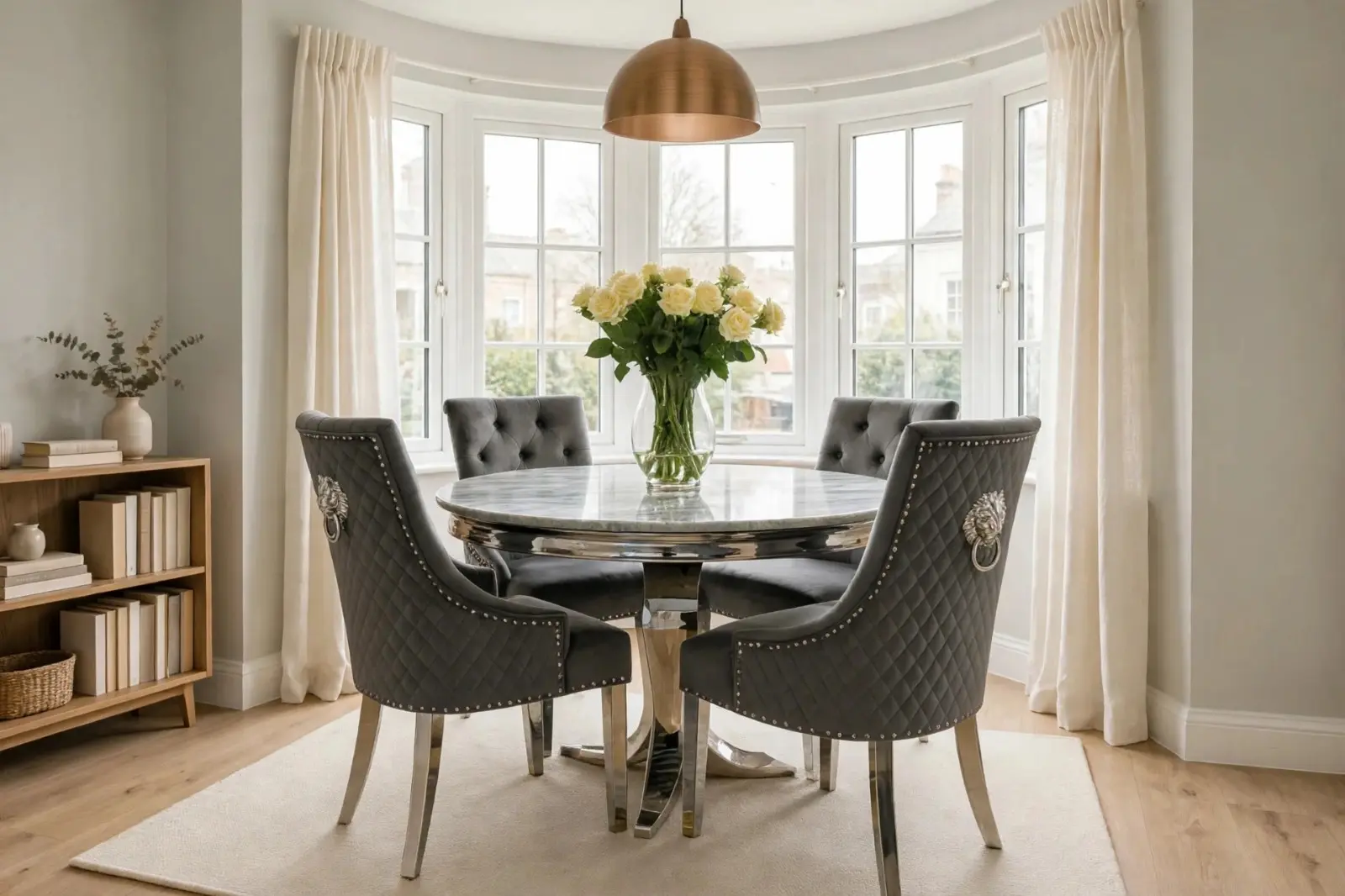
Four people fit comfortably around a 100cm diameter table. A 90cm version works for four for everyday meals, but Christmas dinner with serving dishes will feel tight. If the base is a single pedestal, even better, because nobody ends up straddling a table leg.
For a real example, the Ariana Round Legs Table at Climax Furniture is made for exactly this job — it’s described as ideal for small to medium dining spaces and seats up to four, so it’s a sensible starting point if a round shape suits your room.
The trade-off with any round table is wasted space if you push it against a wall — they work best sitting a little away from the corner of the room.
3. Square table, around 90cm x 90cm
Good for a square-ish dining corner and for couples who mostly eat as two, facing each other, then seat four when friends visit. It is less flexible for adding a fifth or sixth person, so it suits true 4-seater households rather than would-be hosts.
4. Drop-leaf or gateleg table
These are unfashionable in showrooms and brilliant in real flats. With the leaves down, the table might be only 60cm to 90cm wide and can sit against a wall as a console or breakfast table. Fold the leaves up and it becomes a proper 4-seater, sometimes a snug six.
If your dining area doubles as a hallway, home office or living room, this flexibility is worth more than a fashionable finish.
Best 6-seater dining tables that still suit a small home
A 6-seater in a small home needs to earn its place. The best options are rarely the biggest ones.
1. Rectangular table, 150cm to 180cm x 90cm
For a fixed 6-seater, 150cm x 80cm is the minimum that feels believable: 50cm to 55cm per person on the long sides, plus one at each end if needed. It’s snug. 180cm x 90cm is the comfortable version, giving a proper 60cm per person and enough width for sharing dishes.
If your room can genuinely take 180cm — with the 75cm clearance rule still intact — this is a lovely, straightforward table. A statement option like the Turkish Dining Table Set, which comes with a choice of four or six chairs, suits this kind of room better than a tiny kitchen-diner. If your room can’t take it, don’t force it. A fixed table that’s too big will annoy you far more often than guests will thank you for it.
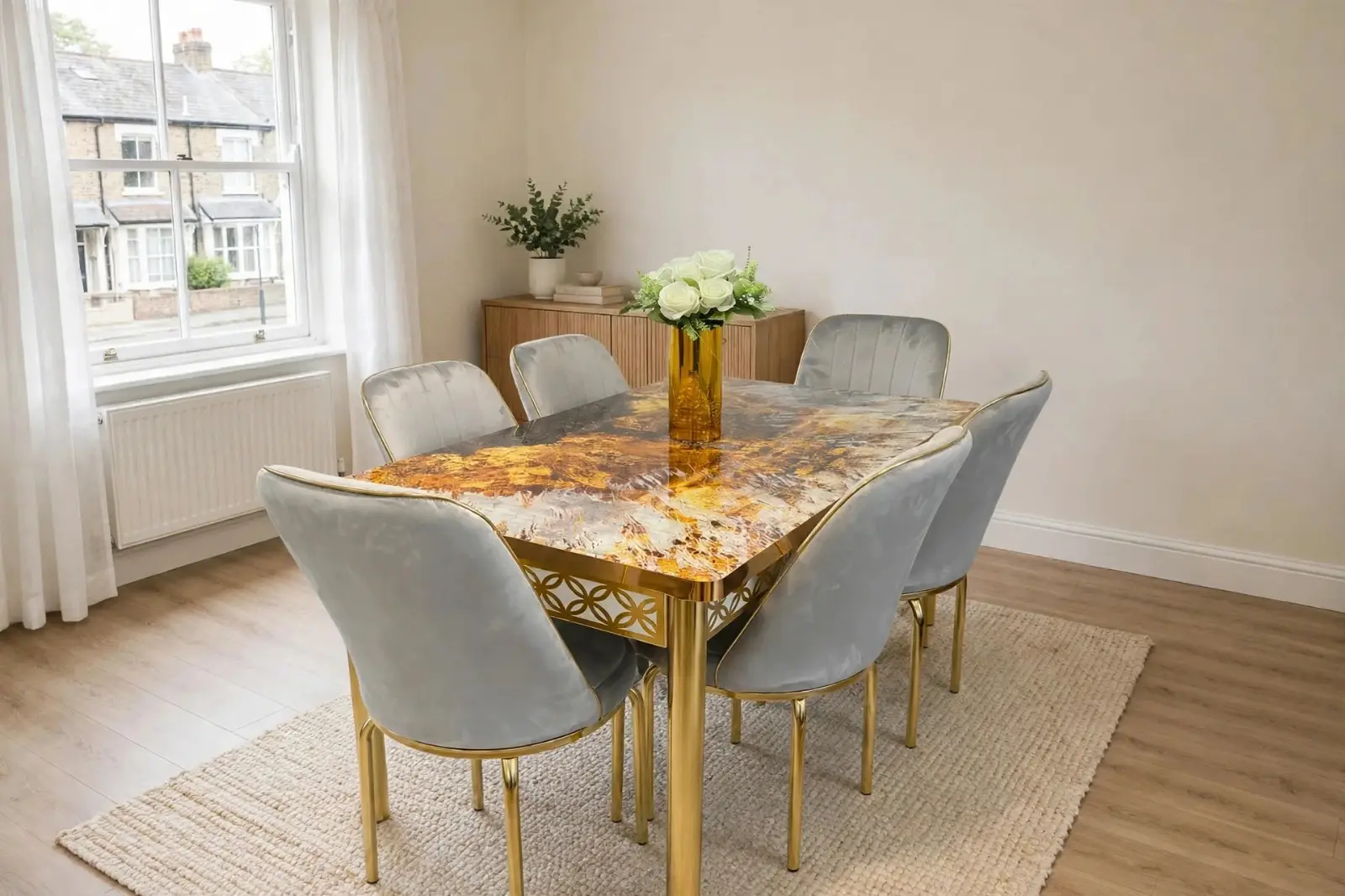
For many small homes, this is the honest answer, and Climax’s dining range shows why. The Luxury Grey with Gold Marble Dining Table measures 130cm x 80cm closed — a neat everyday 4-seater — and extends to 170cm to seat six when you need it. The Grey & Silver Marble Dining Set follows the same 130cm-to-170cm pattern and comes with six chairs included, so the extra seating is already solved.
2. Extending table — the small-home answer
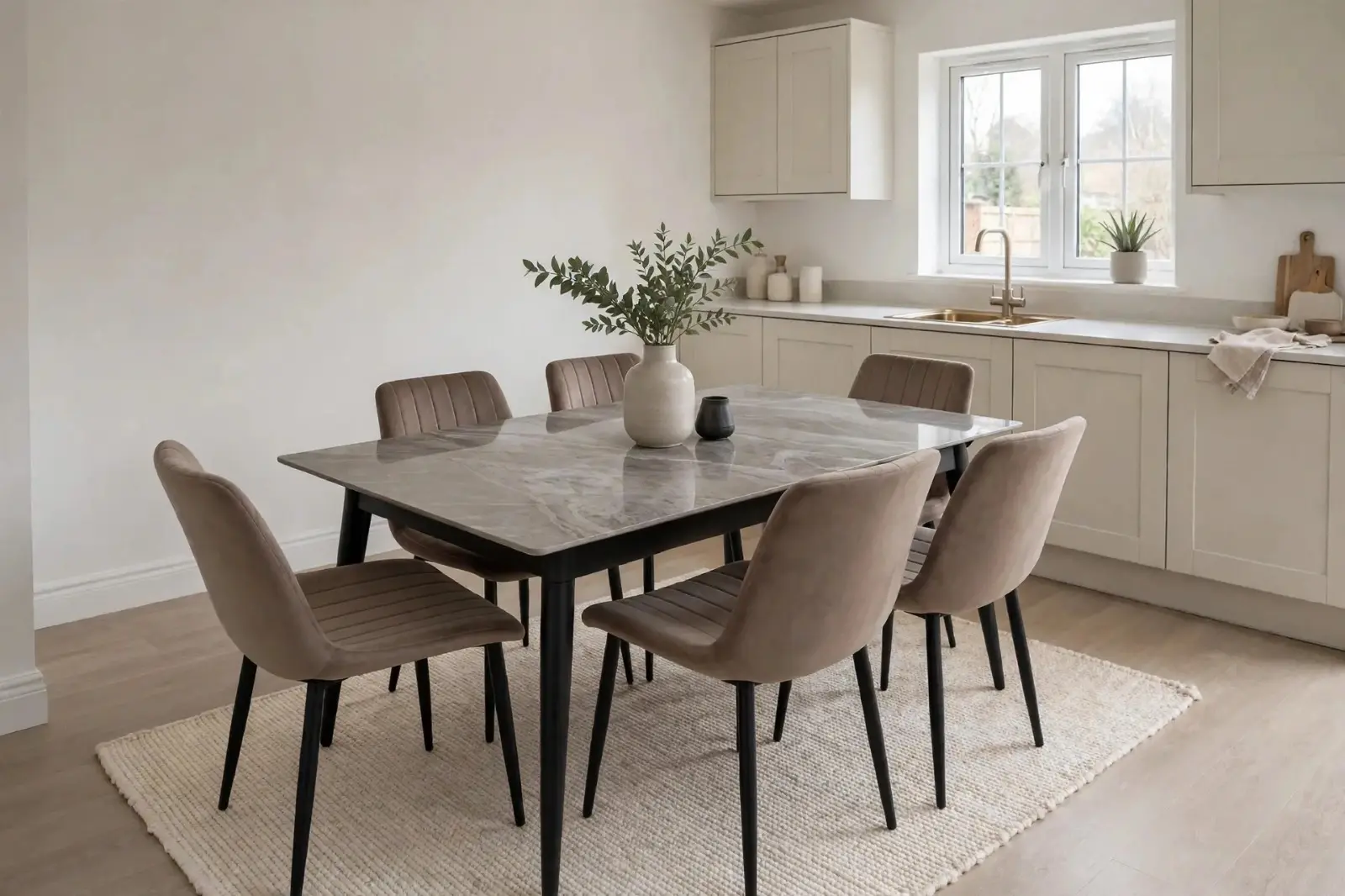
Hosting even bigger gatherings? The Aria Modern White Marble Effect Extending Dining Table starts at 160cm for six and extends to 220cm for eight — the Christmas Day option, in other words, without living around a 220cm table all year.
Whichever extending table you look at, check how it extends. A butterfly leaf that folds inside the table is easiest — no hunting in the under-stairs cupboard for a separate panel on Christmas morning. Separate leaves give a sturdier, simpler mechanism but need storage space. Either is fine, just check that one person can open it without a struggle and that the legs don’t move into an awkward position when it’s extended.
3. Bench seating on one side
A bench can save a surprising amount of space. Chairs need room to pull out. A bench can slide under the table when not in use and will happily seat three smaller people or children along one side where two chairs would normally go.
It is not for everyone — older relatives and anyone staying for a long Christmas lunch will usually prefer a chair with a back — but as a flexible option on one side only, it works well.
Extending vs fixed: which should you choose?
However nice a fixed table looks, make this decision on use, not appearance.
Choose fixed if you seat the same number almost every day, the room passes the clearance test, and you value sturdiness and simplicity. Fewer moving parts, no join line down the middle, and usually a lower price for the same size.
Choose extending if your daily number and your hosting number are different — which, in practice, is most small UK homes. Two people on a Tuesday, six on Christmas Day. That gap is exactly what an extending table was made for.
This is where many people make mistakes in the Black Friday sales. They see a large fixed table heavily discounted and think they’ve found a bargain for Christmas. The reality is, a lot of dining furniture is bought in the Black Friday sale for Christmas dinner specifically. Retailers know it, delivery slots fill up because of it, and buyers are thinking about that one meal. That’s understandable. Just remember you’ll live with the closed — or, for a fixed table, permanent — size in January too.
If it’s extending, practise the thought experiment: where do the extra chairs live for the rest of the year? Folding chairs or stackable chairs that can go in a bedroom corner or cupboard complete the plan. A brilliant extending table with nowhere to store two extra chairs is only half a solution.
Shape, legs and materials in a tight space
A few practical details make a bigger difference than the catalogue photo suggests.
Glass or light-coloured tops can make a room feel less crowded because light passes through or reflects, but glass shows every fingerprint and can feel cold and noisy with plates and cutlery. Marble-effect tops — like the ones on the extending tables above — give you the light, smart look without the weight and upkeep of real stone, and they wipe clean. Solid wood is warm and forgiving of knocks, but a thick, dark top with chunky legs can look — and feel — heavy in a small room.
Slim legs placed at the very corners give you the most usable seating space underneath. Pedestal bases free up the sides completely. Avoid tables with a deep frame under the top if your household includes taller people; that hidden rail is often what steals knee room.
And check the chairs as carefully as the table. A table can be perfect on paper and then fail because the chair arms don’t slide under it, or the chair width means only one fits per side instead of two. Allow about 45cm to 50cm width per chair, and measure the height of the table underside if you want armchairs at the ends. Climax’s own Dining Chairs Collection guide is worth a read on pairing chairs with tables — it makes the same point about chairs fitting properly under the table, and covers standard table and seat heights.
Buying in the Black Friday sale for Christmas: a sensible checklist
If Christmas is your deadline, work backwards.
Order early enough for delivery, assembly and — if something arrives damaged — a replacement. Late November discounts are tempting, but delivery slots for large furniture narrow quickly in December, and a table that arrives on 23 December with a missing fitting is not a bargain.
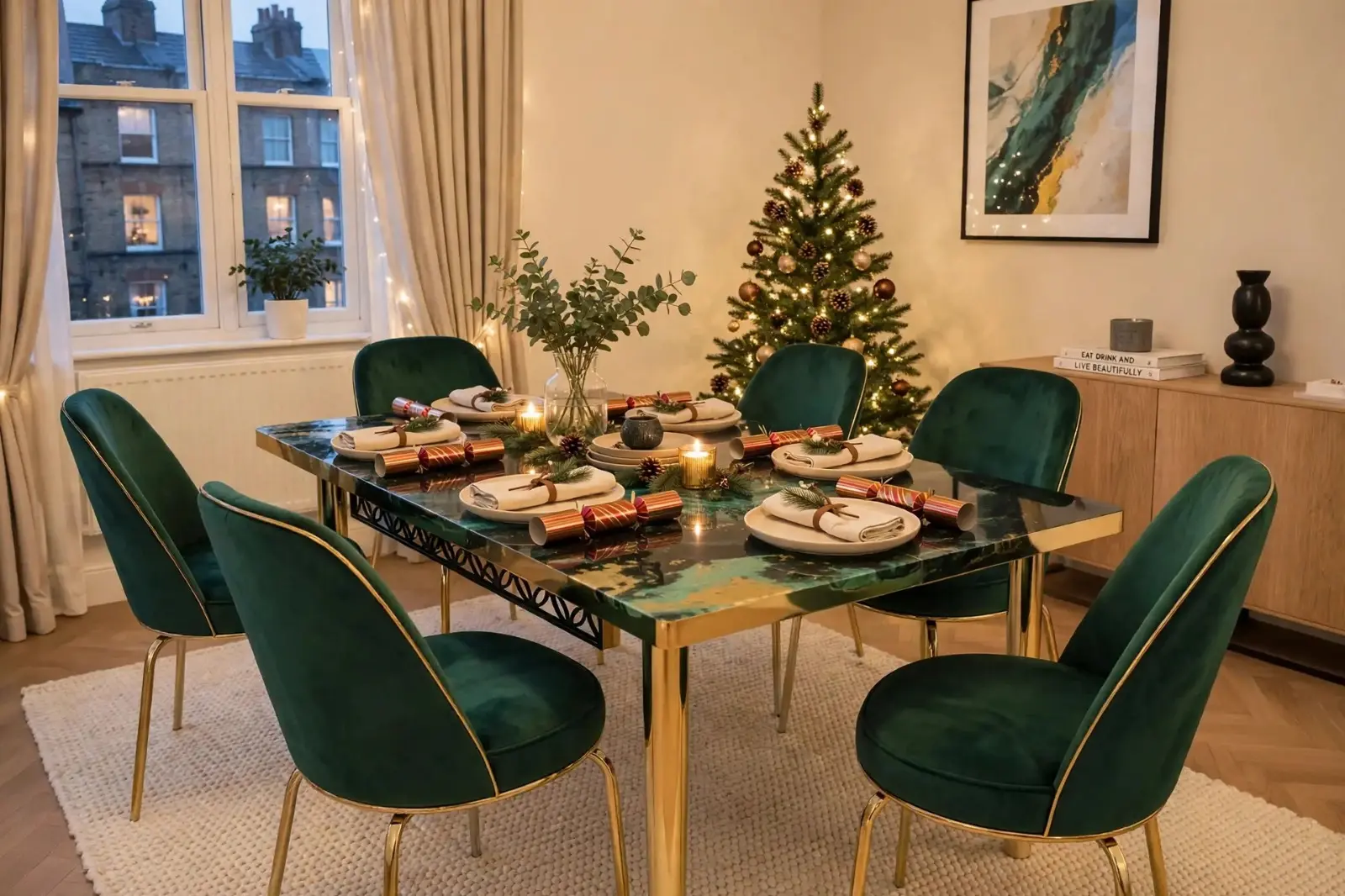
Before you pay, confirm four things: the closed and extended dimensions, the delivery date in writing, whether it comes flat-packed or assembled, and whether the price includes delivery. Then check the route into the room. UK hallways, tight stair turns and narrow doorways — many are only around 78cm to 80cm wide — have defeated more dining tables than room size ever has. Measure the doorway, hallway and any turn, not just the dining area.
Two outside checks are worth five minutes each. First, Which?’s Black Friday shopping tips explain how to research a product’s price history before you buy — when Which? investigated, most Black Friday “deals” had been available at the same price or cheaper at other times of the year, so look at the actual price, not the claimed saving. Second, know where you stand if delivery goes wrong: it’s the seller’s responsibility to get the item to you, and Citizens Advice provides a template letter for complaining about non-delivery if you ever need it.
Finally, don’t forget that the place settings at Christmas are bigger. Turkey platter, gravy, wine glasses, crackers, a centrepiece if you bother. If your everyday calculation is exactly 55cm per person, Christmas will feel cramped. That’s another quiet argument for extending: everyday comfort, festive breathing room. And if those Christmas guests are also staying the night, that’s a separate small-home problem — one that sofa beds solve rather neatly, but that’s an article in itself.
FAQs: Best Dining Tables for Small UK Homes
What size is a 4-seater dining table?
Most comfortable 4-seaters are around 120cm x 75cm rectangular, 90cm to 100cm round, or 90cm square. Anything much smaller will seat four, but serving dishes in the middle become difficult.
What size table do I need for 6 people?
Aim for 150cm x 80cm as a minimum and 180cm x 90cm for comfort. That gives roughly 55cm to 60cm per person. A round table for six needs about 120cm to 135cm diameter, which is harder to fit in a small room.
Is a round or rectangular table better for a small room?
Rectangular tables use wall space more efficiently and are easier to push aside. Round tables are better for circulation and tight corners where people need to walk past. Choose based on the shape of your room, not just its size.
How much space should I leave around a dining table?
Leave 75cm to 90cm from the table edge to the wall so chairs can pull out. Leave 90cm to 120cm if people need to walk behind someone who is seated.
Are extending tables worth it?
Yes, if your everyday household is smaller than your hosting group. The Grey with Gold table linked above is a good illustration: 130cm and four seats day to day, 170cm and six seats when extended. They are especially useful in small UK homes where a permanent 6-seater would dominate the room but Christmas and family meals still need six seats.
Can a 4-seater table seat 6 for Christmas?
Sometimes, at a push — one person at each end and two on each side — but it will be tight at 120cm long, with very little room for serving dishes. If you host six regularly, choose a 4-seater that extends rather than relying on squeezing in.
Conclusion
The best dining table for a small UK home is not the largest one you can physically fit through the door. It’s the one that leaves you room to move on an ordinary Tuesday, seats your household properly, and can still rise to the occasion at Christmas without turning the whole room into a dining room and nothing else.
Start with 60cm per person, protect your 75cm of clearance, and be honest about how often six people really sit down together. If that’s weekly, a fixed 150cm to 180cm table may be right. If it’s mainly festive, an extending 4-seater that opens to six will probably serve you better — and you’ll enjoy the extra space for the other eleven months.
Measure the room, the doorway and the chairs. Then, if you’re buying in the Black Friday sales, buy in time for a calm December delivery. You can browse the full range — extending, round and fixed sets — at Climax Furniture. Christmas dinner is stressful enough without assembling a table on Christmas Eve.