

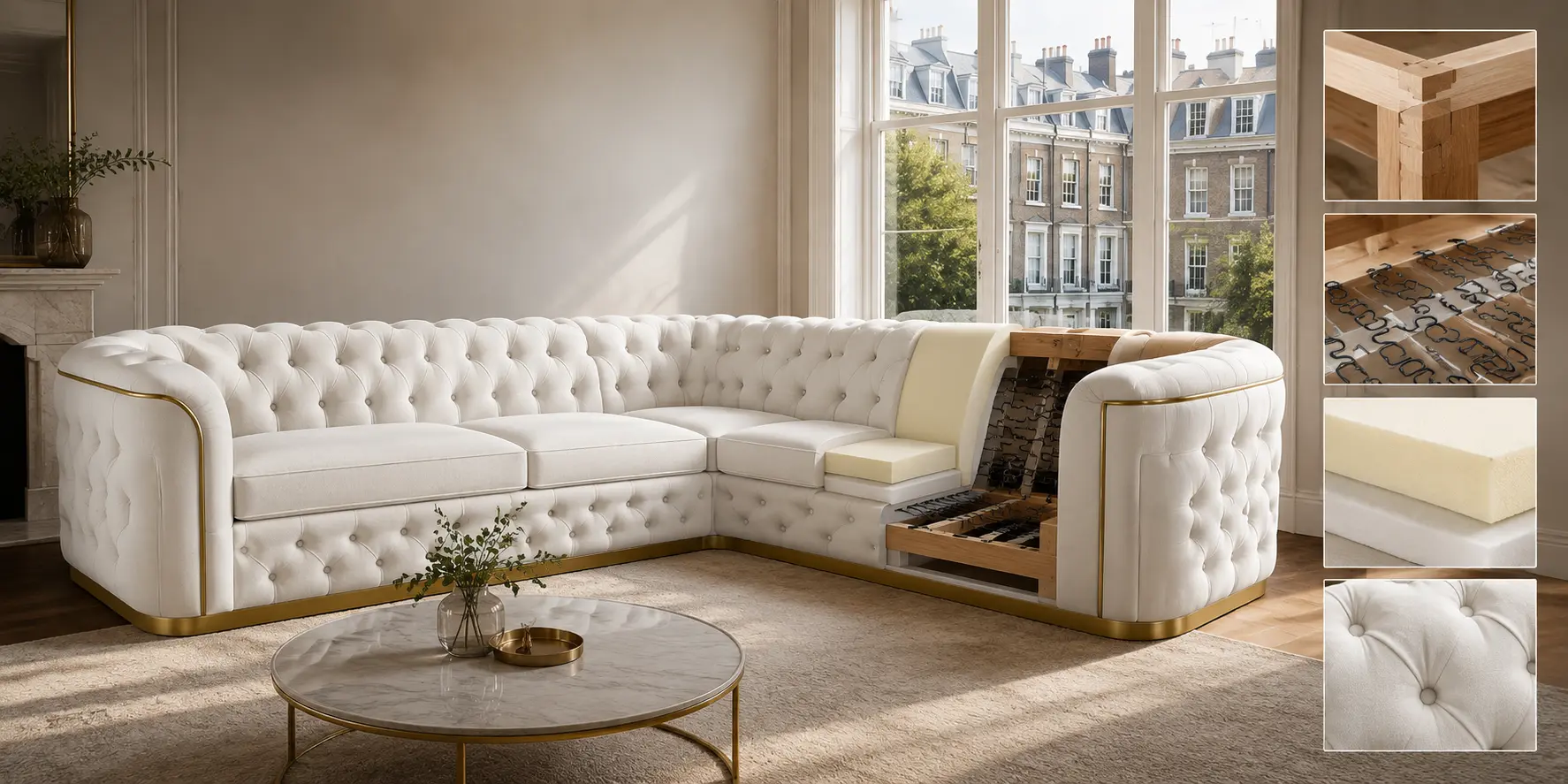
What Makes an Authentic Turkish Sofa? Materials, Joinery & Quality Standards

You have spent several weeks searching for the best sofa. The sofa you have found appears gorgeous – plush velvet, huge size, with built-in storage, and a mechanism to make it a guest bed almost immediately. However, three months have passed since the moment of purchase, and now it is obvious that the sofa sags, squeaks whenever you use it, and requires effort to open the convertible bed.
An authentic Turkish sofa combines strong wooden frames, soft high-quality cushions, and beautiful fabrics to give your living room long-lasting comfort and style.
This problem is rather frequent and affects many UK homeowners who seek both high functionality and luxurious comfort of living in their houses. There is plenty of sofas that look as gorgeous as Turkish one; however, they lack the quality engineering that makes the Anatolian furniture so durable.
A genuine Turkish sofa should not be evaluated only from the perspective of gorgeous-looking velvet and golden elements. Its durability depends on the complex engineering design, centuries-old wooden working practices, and tough fabric requirements that allow the sofas to survive decades of active family use. There are certain details about which you should learn in order to recognize a real Turkish sofa.
Here they are.
The Anatomic Foundation: Kiln-Dried Hardwood vs. Composite Framing
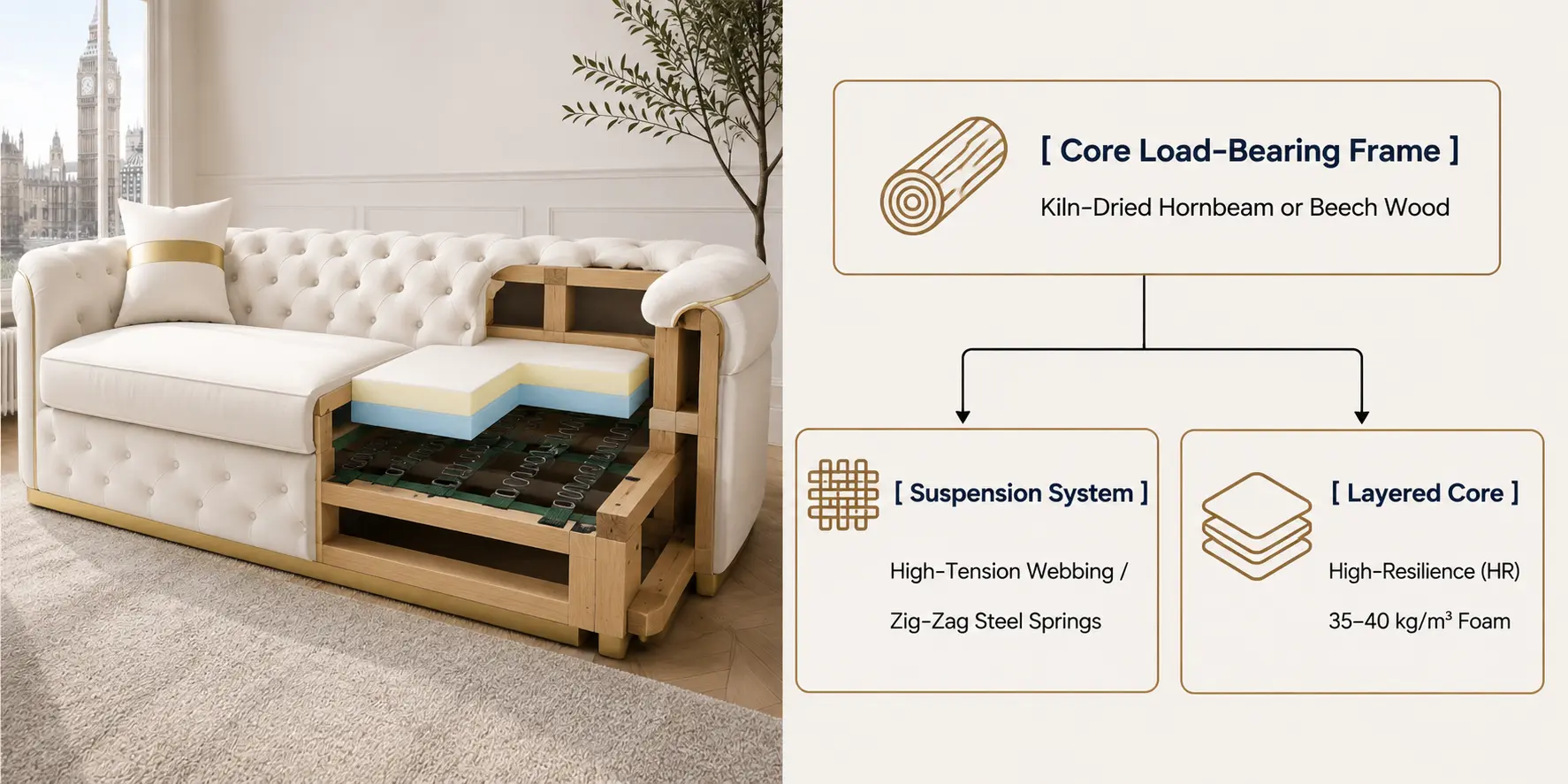
The life and stability of any chair with upholstery depends completely on its skeletal frame. Budget models make heavy use of inexpensive particleboard, soft wood, and thin metal tubes, which bend under stress due to changes in humidity levels indoors in the UK.
Frame Timber Selection
The wood of choice for original Turkish manufacturers is Hornbeam (Carpinus betulus) or European beech (Fagus sylvatica) which are kiln-dried. The Hornbeam is densely grained and highly shock-resistant; thus, it is recommended for impact regions like the joining region of the arm joints and the back rail attachment points.
Moisture in Timber: Timber should be kiln-dried to reduce its moisture content to 8 and 11 percent to prevent warping, splitting of timber, and squeaking due to changes in moisture in the British homes.
Reinforcement Blocks: Hardwood solid blocks are recommended for load-bearing corners and are glued, double doweled, and held in place with steel corner brackets.
Precision Joinery Standards
As opposed to cheap flat-packed or mass-produced promotional furniture made only through the use of staples and PVA glue, Turkish upholstery frame construction involves the use of time-honored methods of joining, combined with industrial glues.
The Mortise and Tenon Joint: The principal supporting beams fit into corner posts via mortise and tenon joints or massive finger joints.
The Mechanical Joint: Wherever metal fastenings such as brackets and bolts are used, flush-mount T-nuts and machine screws are used in place of wood screws.
Understanding the balance between solid joinery, suspension engineering, and high-density cushioning is a fundamental step detailed in our complete Sofa Buying Guide.
Suspension Systems and Mechanical Engineering
For a high-end frame, there must be a good suspension system to cushion the frame against impacts and ensure that the seating cushion does not sag prematurely. Turkish sofa construction utilizes two main suspension systems, usually combined.
| Suspension Type | Material Specification | Ideal Application | Performance Advantage |
| High-Tension Sinuous (Zig-Zag) Springs | 3.8mm to 4.0mm carbon-tempered steel wire | Deep-seat lounge configurations & convertible beds | Maintains tension across wide spans without sagging |
| Elasbelt Elastic Webbing | 60%–70% natural rubber latex threads woven with polypropylene | Firm profile seating & slimline tuxedo frames | Eliminates spring noise; distributes weight evenly across tight seat bases |
| Pocket Spring Cores | Encapsulated steel coils built directly into seat foam | Premium multi-functional seating | Delivers independent point-elastic support without transfer motion |
In case of multi-functional furniture, such as Turkish sofa beds that come with built-in storage units or roll-over click clack mechanisms, the metal frame inside needs to be made of cold rolled steel with anti-corrosive powder coating through the use of electrostatic method.
For additional insights on styling and sourcing imported furniture across British homes, you can also consult this complete guide to premium Turkish sofas in the UK.
Cushioning Density and Ergonomic Architecture
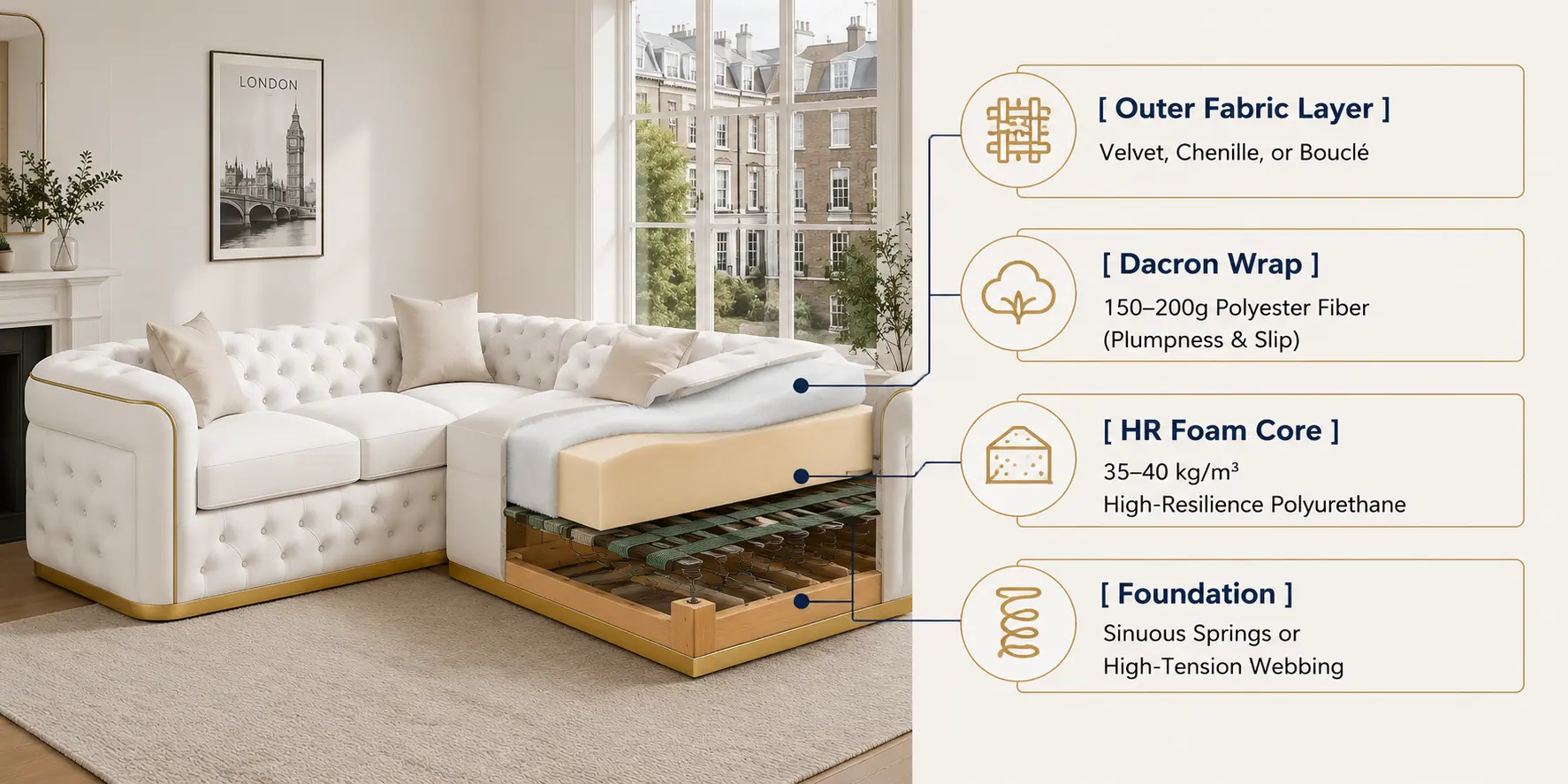
Comfort and durability of the sofa rely on the quality and density of foam used inside the sofa. The genuine manufacturers of Turkish furniture do not use low density polyurethane foam in their products because it wears out within 12 to 18 months.
Foam Density Grades
35-40 kg/m³ HR (High Resilience) Foam: The highest quality foam for seats’ main cushion. High Resilience foam is characterized by open-cell composition which immediately bounces back to its original shape upon removal of pressure.
Hyper-Soft (HR) Layering: Cushioning material is normally composed of a 2-3 cm thick layer of 30 kg/m³ hyper-soft foam overlaid by 200g polyester Dacron fiber.
Fire Retardancy Requirements: In order to meet the fire retardancy requirements of the UK market, all internal foams should adhere to the 1988 UK Furniture and Furnishings (Fire) (Safety) Regulations (BS 5852 standard).
Textile Standards: Sheen, Martindale Wear Ratings & Maintenance
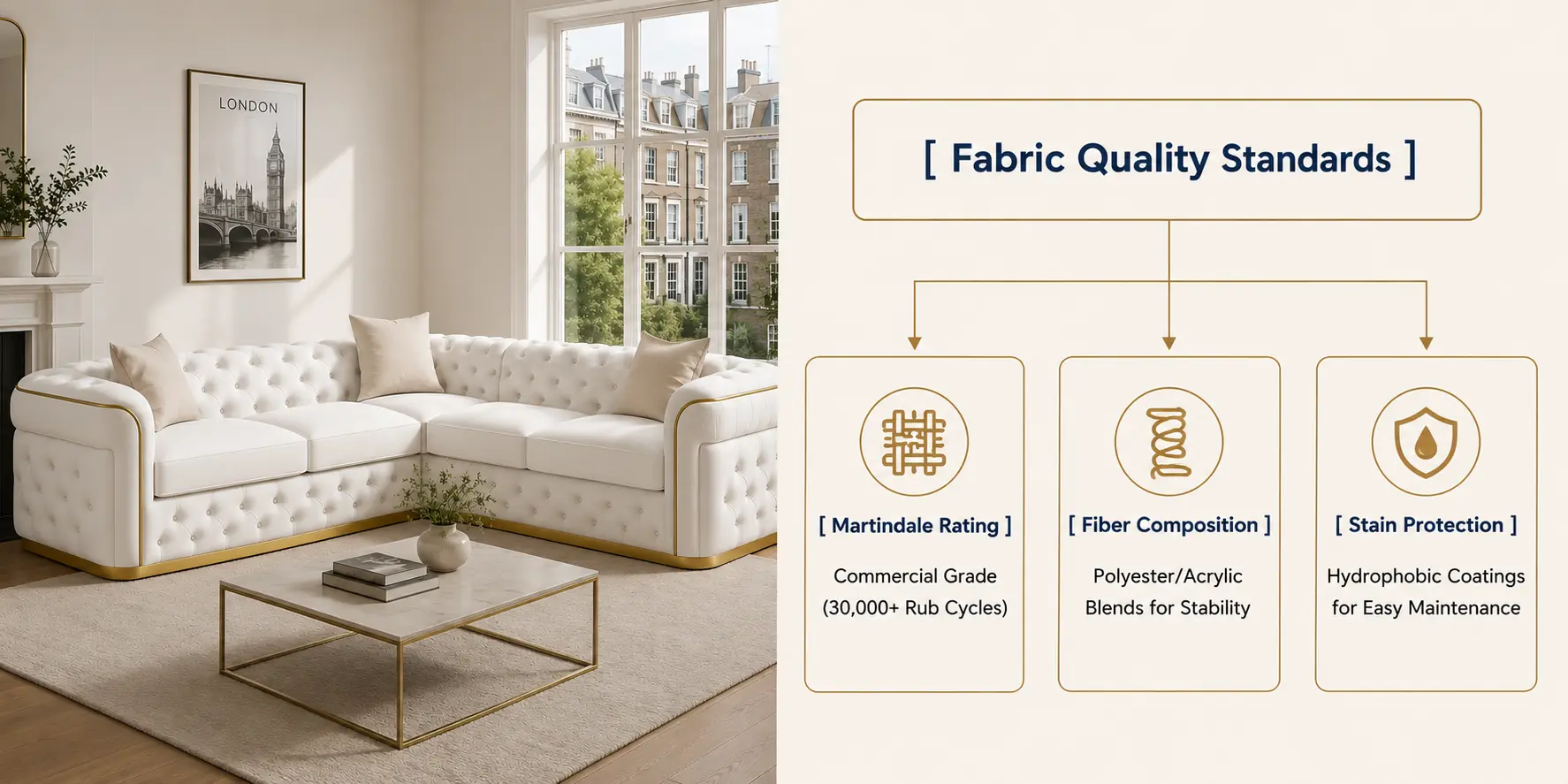
The exterior upholstery of the real Turkish sofas has luxurious textures with high density of crushed and matte velvet, chenilles and bouclé, and synthetic fibers that have stain resistance features. In the Climax Furniture line of products, luxurious look comes with stringent technical specifications for fabrics to withstand activity in British homes.
Technical Fabric Benchmarks for the UK Market
Martindale Abrasion Test: Authentic Turkish fabric suitable for home use in UK living rooms must meet the requirements of at least 30,000 to 50,000 rubs in the Martindale abrasion test method. For heavily used family homes and multi-functional sofa beds, Climax Furniture uses fabrics with commercial-grade qualities which are able to endure at least 50,000 rubs to withstand pilling, abrasion, and fiber wear.
Color Fastness to Light Test: The rich jewel colours of emerald green, royal blue, mustard and terracotta will be tested against BS EN ISO 105-B02 (graded 1-8). The minimum standard of 5+ ensures that these coloured fibres will not fade even if exposed to bright sunlight in the conservatories of UK homes or bay windows.
Hydrophobic & Easy-Clean Nanotechnology: Our high-end Turkish upholstery range features a special stain-resistant treatment on the yarn level. The effect of hydrophobic technology means that any spilling of liquids, for example, tea, coffee, or water, results in beading of the liquid droplets instead of their soaking into the material.
UK Fire Regulations (Compliant with BS 5852): All the fabrics in our range of Upholstery Furniture are rigorously tested for matches and cigarette ignition in accordance with the Furniture and Furnishings (Fire) (Safety) Regulations 1988.
Architectural Details and Signature Craftsmanship
Authentic Turkish sofa design is instantly recognizable by its balance of grand proportions, intricate tailored seams, and exposed structural or decorative elements.
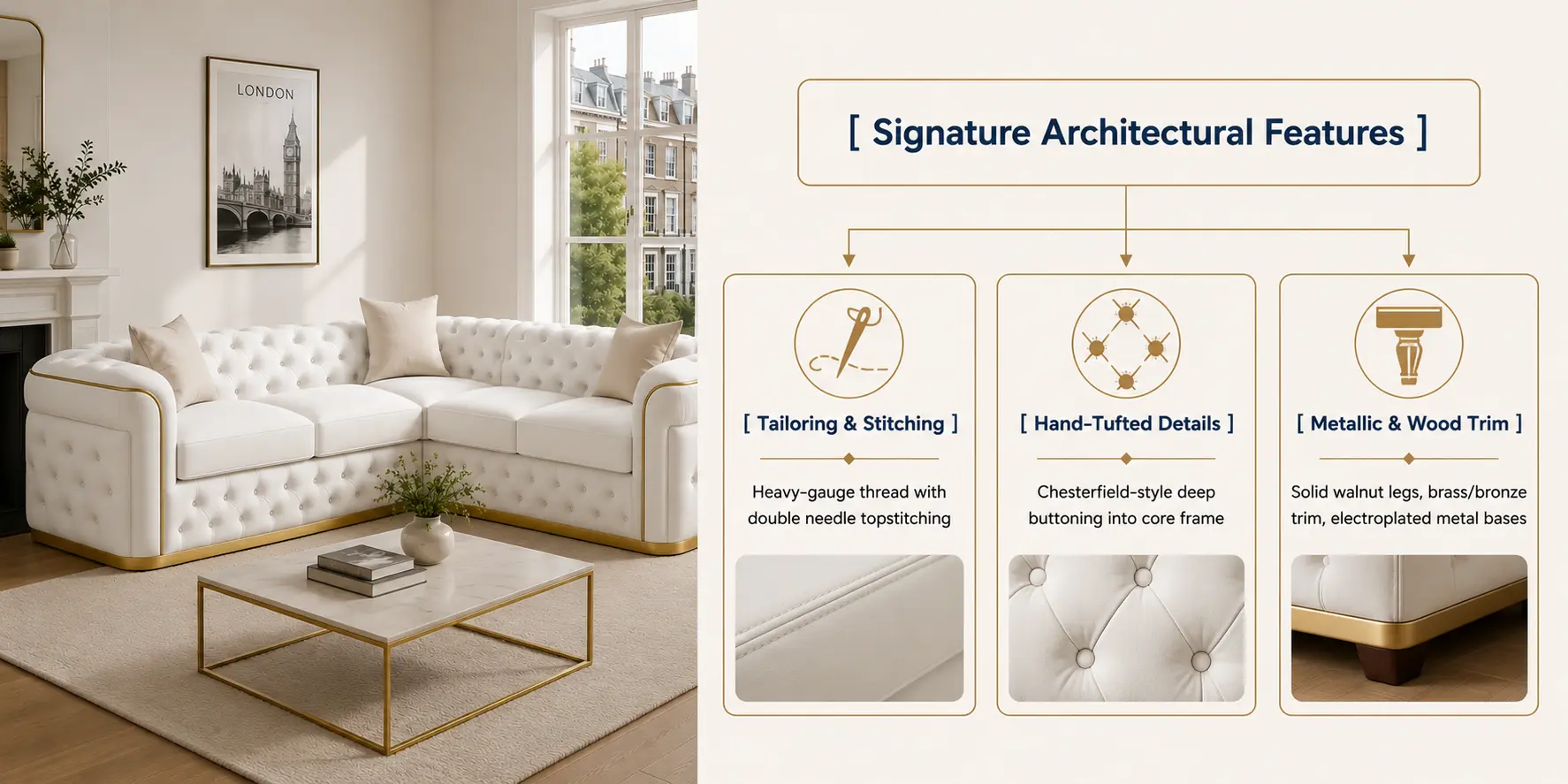
Deep Button Tufting: The traditional Turkish button tufting process involves attaching buttons directly to the frame structure or high-density foam base by heavy nylon string, forming deep geometric diamonds.
Edge Piping and Fluting: Clean vertical lines and perimeter welted edges necessitate careful hand-stitching with bonded heavy nylon thread in order to avoid seams ripping apart under the pressure of use.
Metal and Wood Trim: The metal base should be made out of electroplated stainless steel or brass, but not cheap thin paint coating, as this would make the base resistant to scratches and corrosion. The wooden base is usually made out of walnut or beech wood and lacquered.
For spacious modern living rooms, many of these premium structural standards can be explored across our curated list of the Best Corner Sofas in the UK.
How to Spot Imitations: Red Flags & Inspection Checklist
In the event that you are buying an authentic Turkish sofa in the United Kingdom, the following construction cues should be checked before purchase:
Weight Distribution: When buying authentic Turkish furniture that uses solid hornbeam frames and high-density foam, the piece is quite heavy. A three-seater sofa that can easily be lifted by one person probably consists of light soft wood and hollow composite boards.
Inspection Underneath the Base: Check underneath the base of the sofa. Top manufacturers use breathable dust covers that are tightly stapled over neatly attached spring anchors rather than uncovered and unprotected wood.
Pulling the Seam Fabric: When pulling the seam fabric gently along seam lines, authentic high-quality stitching uses tight stitches without thread exposure or gap when pulled.
Opening Mechanism: In case the Turkish sofa model being purchased is convertible, test the opening mechanism. Authentic metal frame uses smooth operation with one hand through counterbalance springs or gas strut pistons.
Frequently Asked Questions
What type of wood is most commonly used in authentic Turkish sofa frames?
Kiln-dried hornbeam and European beech are the standard woods used in authentic Turkish manufacturing. Hornbeam is preferred for high-stress joints due to its high grain density and shock resistance, while beech is widely used for main load-bearing side rails.
How do I ensure a imported Turkish sofa meets UK fire safety regulations?
Ensure the sofa bears a permanent UK Fire Safety Compliance label stating adherence to the Furniture and Furnishings (Fire) (Safety) Regulations 1988 (BS 5852). The internal foam, interlining, and outer fabric covers must all meet flame-retardant standards.
Are Turkish sofa beds sturdy enough for daily sleep use?
Yes, provided they are built with heavy-gauge, cold-rolled steel mechanisms and pocket-sprung or high-density HR foam mattresses. Unlike light guest beds, daily-use Turkish sofa beds utilize heavy-duty metal chassis rated for repeated folding cycles.
What is the ideal foam density for long-lasting seat cushions?
Look for a minimum density of 35 kg/m³ to 40 kg/m³ High Resilience (HR) foam for main seat cushions. Lower densities (such as 20–25 kg/m³) break down rapidly under daily use, causing hollows and sagging.
How do you clean high-pile Turkish velvet or chenille upholstery?
For daily maintenance, vacuum the upholstery weekly using a soft brush attachment in the direction of the nap. For liquid spills, blot immediately with a clean, dry microfiber cloth. Avoid harsh chemical detergents; use water-free solvent cleaners or specialized upholstery shampoos after spot-testing an inconspicuous area.
What is the difference between S-springs and elastic webbing in sofa construction?
S-springs (sinuous steel wire) provide a springier, resilient bounce suitable for deep lounge seating and heavy weight loads. Elastic webbing (Elasbelt) offers a firmer, quieter base with uniform tension, making it ideal for sleek, contemporary frame profiles.
Maintaining Long-Term Value
The authentic Turkish sofa is truly an investment for your house concerning longevity of structure, comfort of sitting, and design uniqueness. Being aware of the engineering principles of the item—kilot-dried hornbeam frames, 40 kg/m3 HR foam, and fabric tested by Martindale standard—can help you make the right choice. Consider your way of life, check the fire safety certificates, and focus on framing and suspension rather than just exterior.
Shop at Climax Furniture | WhatsApp Us: +44 7511 163716
Explore More: www.climaxfurniture.com
Follow Climax Furniture:
Facebook | Instagram | Pinterest | LinkedIn | X (Twitter) | YouTube